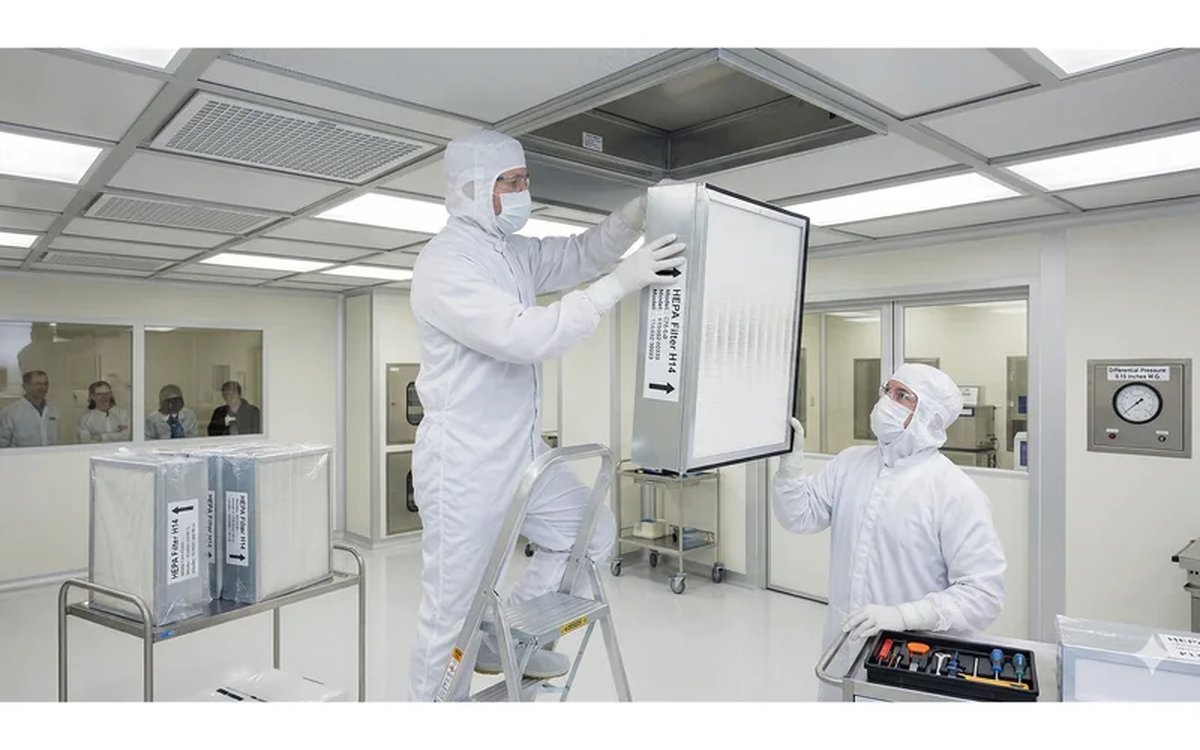
Nobody on an advanced packaging line is worried about the "99.97% @ 0.3 μm" line on the spec sheet. They are worried about how many particles the filter itself drops.
Why Advanced Semiconductor Packaging Now Needs 350–600°C
Heat-resistant HEPA filters used to be sold mainly to industrial ovens, paint lines, and pharma drying. The real customer base in the last 5 years has shifted — to advanced semiconductor packaging.
Where the heat is:
- ▸PCB multilayer lamination: 250–280°C × 60–90 min
- ▸SMT reflow: peak 260°C, brief but extremely high frequency
- ▸Wafer back-grind bake: 300–400°C
- ▸HDI / mSAP fine-line interconnect post-processing: 350°C+
- ▸Glass-carrier debonding: 400–500°C
- ▸Flip-chip underfill cure, ESD sintering, 3D stacking: 500–600°C
Advanced packaging used to rely on ULPA + FFU to maintain ISO Class 5 — all at room temperature. The newer technologies (HBM, CoWoS, Fan-Out, SoIC) bring high-temperature steps into the cleanroom itself, and at that point the heat-resistant HEPA in exhaust ducting, return paths, and oven housings becomes the cleanliness bottleneck for the entire process.
Why 350–600°C specifically? It's the sweet spot where "polymers still work, organic underfill cures, glass carriers release, alloys don't melt." Above it you need ceramic media and a completely different facility design.
Efficiency Is the Myth — Self-Shedding Is the Real Gate
Open any heat-resistant HEPA datasheet and the biggest text is always "99.97% @ 0.3 μm" or "99.99% @ 0.3 μm". Reassuring.
But what does that number actually measure?
"Capture efficiency" ≠ "Self-shedding at temperature"
- ▸Capture efficiency: feed known particles (PAO or DOP oil mist) from upstream, measure what makes it downstream — this is "how much external dirt is blocked."
- ▸Self-shedding: broken glass fibers, cracked resin, peeled sealant that the filter itself releases at high temperature — this is "how much the filter drops on its own."
These are completely different measurements.
Why self-shedding is uniquely scary
Capture efficiency measures 0.3 μm fines (HEPA's MPPS region). What the filter sheds during 350°C cycling is typically 10–30 μm broken glass fibers — one to two orders larger than what the spec measures.
For an advanced-packaging wafer, a 10 μm glass fiber landing in a process chamber is a hundred times worse than a 0.3 μm fine — it crushes bond wires, scratches the wafer surface, and wedges into solder-ball gaps.
How can a "99.99%" filter shed glass fiber?
Easily. Three reasons:
- 1The spec is measured cold (25°C) — high-temperature behavior is not tested
- 2The spec measures "incoming particle capture rate," not "self-shedding rate"
- 3UL900-style fire-safety standards only test "flame spread / smoke during combustion," not microscopic shedding under steady-state heat
Bottom line: for a heat-resistant HEPA, the "capture efficiency" line is not the deciding number. In a 350°C cycling environment, "low shedding through ramp / cool transients" is the real gate.
How to Measure Self-Shedding
There is no unified self-shedding standard for heat-resistant HEPA the way EN 1822 covers efficiency. The practical procedure:
- 1Pre-bake: place the filter in a heat-resistant tunnel, 350°C continuous heating for 20 hours — flushes out the "manufacturing-residue spike" that every new filter has on first heat-up
- 2Measurement run: execute one full heat cycle (0.5 h ramp + 1 h hold + 1 h cool)
- 3Downstream particle counting: an ISO 21501-grade particle counter samples each 0.1 cubic foot, tallying every particle ≥0.3 μm
Chart 1: Heat-Resistant HEPA Self-Shedding Test — Apparatus & Temperature Curve
Filter is pre-baked at 350°C for 20 continuous hours, then runs one full heat cycle while a particle counter downstream tallies 0.3 μm+ particles in real time
Why pre-bake 20 hours? A brand-new filter releases the most manufacturing residues and short-lived volatiles on its first heat-up — measuring without pre-bake would severely overstate the "real operating" shed rate. After 20 h, what remains is the filter's "long-term steady-state" self-shedding behavior — the only number that matters for procurement.
The 20-hour pre-bake is critical. A brand-new filter always sheds on first heat-up — manufacturing organic residues, partially-cured resin, and volatiles accumulated during transport are all flushed in the first temperature ramp. Without pre-baking, every filter looks bad and the long-term steady-state difference is invisible.
After pre-bake, what you measure is the number procurement should care about — the filter's actual long-term behavior in production.
Same 99.97% — 40× Difference in Practice
Two heat-resistant HEPAs with identical spec sheets:
- ▸Capture efficiency 99.97% @ 0.3 μm
- ▸Rated continuous temperature 350°C
- ▸Both certified to EN 1822 H13
After running them through the pre-bake + measurement protocol above, here are the downstream particle counts. The original paper plotted the two filters on different Y scales (Taiwan 0–2,500, Japan 0–250), which understates the gap. We redraw both on a shared Y scale (0–2,500) so the order-of-magnitude difference is unmistakable:
Chart 2: How Two "99.97% @ 0.3 μm" HEPAs Actually Behave at 350°C
Same test conditions, same spec sheet, 40× difference in downstream particle count
Not media efficiency — both filters pass 99.97% @ 0.3 μm. The gap is in process precision: Japanese makers tighten glass formulation, resin content, thermal-shrinkage control, and the thermal-expansion match between sealant and frame. Taiwan-made units typically use generic formulations with looser tolerances; under 350°C ramp / cool, the filter "breathes" — fibers rub, resin cracks, sealant peels — and the whole pack sheds. The cruel irony: most of those shed fragments are 10–30 μm broken glass fibers — one to two orders larger than the 0.3 μm the spec measures.
Both panels use the SAME Y scale (0–2500 / 0.1 CF) so the order-of-magnitude gap is unmistakable. With independent scales (Taiwan 0–2500, Japan 0–250 as in the original report), the Japan line looks "bumpy" — but on a shared scale, it is essentially flat at zero. The story is not "average is low" but "low even through ramp / cool transients" — and modern advanced packaging cycles in and out of 350°C constantly, so every transient is a self-shedding test.
What to look for
- ▸Ramp (0–0.5 h): both shed during ramp — physics says thermal expansion will loosen something. Magnitudes: Japan-made peak ~50 / 0.1 CF, Taiwan-made peak ~1,900 / 0.1 CF.
- ▸Hold (0.5–1.5 h): Japan-made hugs the zero baseline; Taiwan-made oscillates wildly between 800 and 1,500 / 0.1 CF. Meaning: the Taiwan-made unit is still actively shedding under steady-state 350°C, while the Japan-made unit has settled.
- ▸Cool (1.5–2.5 h): both spike on cool-down (thermal contraction is also physics), but Japan-made returns to zero quickly; Taiwan-made still peaks 400–500 / 0.1 CF.
Why the gap?
Not a media-efficiency difference — both filters pass 99.97% @ 0.3 μm. The gap is in manufacturing precision:
| Dimension | Generic Taiwan-spec | Japan-engineered for advanced packaging |
|---|---|---|
| Glass formulation | Generic E-glass, broad fiber length distribution | Low-boron / boron-free, tight diameter and length control |
| Resin loading | Excess for structural margin → cracks at 350°C | Calculated to minimum; no excess |
| Thermal-expansion match | Designed at room temperature | Sealant, frame, separator CTEs deliberately matched |
| QA | Batch-sample efficiency only | Per-unit low-flow self-shedding screening |
The gap is not in the glass fiber's "particle blocking ability" — it is in whether the glass, resin, sealant, and frame "stay put" under 350°C cycling.
5 Questions to Ask Suppliers
You cannot select a heat-resistant HEPA from a spec sheet alone. Before issuing an RFQ, get answers to these five:
- 1Has a complete self-shedding test been done? At what temperature, with how many hours of pre-bake, over how long?
- 2What were the peak counts during the test? Ramp, hold, and cool phases separately?
- 3Glass formulation: standard E-glass or low-boron / boron-free? Fiber-diameter distribution?
- 4Are sealant and frame CTEs deliberately matched? Has the unit been tested through 100 thermal cycles?
- 5Per-unit self-shedding screening before shipment, or efficiency-only batch sampling?
If a supplier cannot answer all five (or only points to "we have a 99.97% certificate"), the unit should not enter your advanced-packaging line. Filters engineered specifically for this application treat all five as QA acceptance criteria — that is the dividing line between "functional" and "advanced-packaging-grade."
FAQ
Q: Is "99.97%" measured cold? How much does it differ from hot?
A: Cold. EN 1822, ISO 29463, JIS B 9908 are all measured at 20–30°C. The assumption that 99.97% holds at 500°C is common but no mandatory standard requires high-temperature efficiency verification. In practice, media efficiency typically degrades <0.1% at 350–500°C — acceptable. What degrades quickly is self-shedding. So treat the efficiency spec as a cold-temperature floor, and a self-shedding test as the real-world validation.
Q: Are all Taiwan-made heat-resistant HEPAs unusable?
A: No. They are completely fine for applications without sensitive downstream targets — paint-line exhaust, lab fume hoods, industrial oven exhaust — even if they shed glass fragments during ramp / cool, those go straight to atmosphere and never see a wafer. But for advanced packaging, wafer back-process, panel coating, post-CVD — anything with wafers or expensive substrates downstream — choose a model that holds shedding low and stable, regardless of country of origin.
Q: Does the gap widen with more thermal cycles?
A: In theory yes. A structurally less-stable filter degrades cumulatively under thermal cycling — more resin cracks, more sealant peel, more cumulative fiber breakage. Industry rules of thumb use "self-shedding measured after 100 thermal cycles" as a durability gate. A precision-grade unit might still peak under 100 / 0.1 CF after 100 cycles; a generic-grade unit can climb above 5,000.
Q: Does UL900 certification say anything about self-shedding?
A: UL900 measures "flame spread and smoke generation in ambient HVAC duct" — it cares about what happens during a building fire. It says nothing about self-shedding under steady-state heat. A UL900 Class 1 filter can still shed glass fibers like crazy at 350°C — UL900 does not test that. Don't treat UL900 as evidence of "clean at temperature."
Q: How is the particle counter set up? Does it need to handle 350°C?
A: It does not — a particle counter cannot enter the hot zone. The practical setup uses an insulated stainless sampling line that cools the downstream sample to <80°C before it reaches the counter (the line needs an in-line particle-loss calibration so wall deposition does not bias the measurement). TSI, Lighthouse, and Met One ISO 21501-4 0.3 μm counters are all suitable.
Q: Beyond self-shedding, what else is missing from spec sheets?
A: Three things. (1) Long-term ΔP drift — how much does pressure drop rise after 1,000 h at 350°C? (2) Thermal-cycle durability — frame deformation and sealant integrity after 100 ramp / cool cycles? (3) Gaseous emissions — boron oxide (B₂O₃) in the glass fiber slowly volatilizes above 450°C, and that number matters for P-type doping environments. All three require historical test data from the supplier — none are visible on a spec sheet.
Related Standards
- ▸EN 1822 / ISO 29463 — HEPA / ULPA efficiency grading (room-temperature test)
- ▸JIS B 9908 / B 9927 — Japanese filter test methods
- ▸UL 900 — HVAC duct filter combustion behavior (unrelated to self-shedding)
- ▸ISO 21501-4 — light-scattering particle counter specification
- ▸SEMI F21 — Airborne Molecular Contamination classification, includes advanced-packaging reference limits