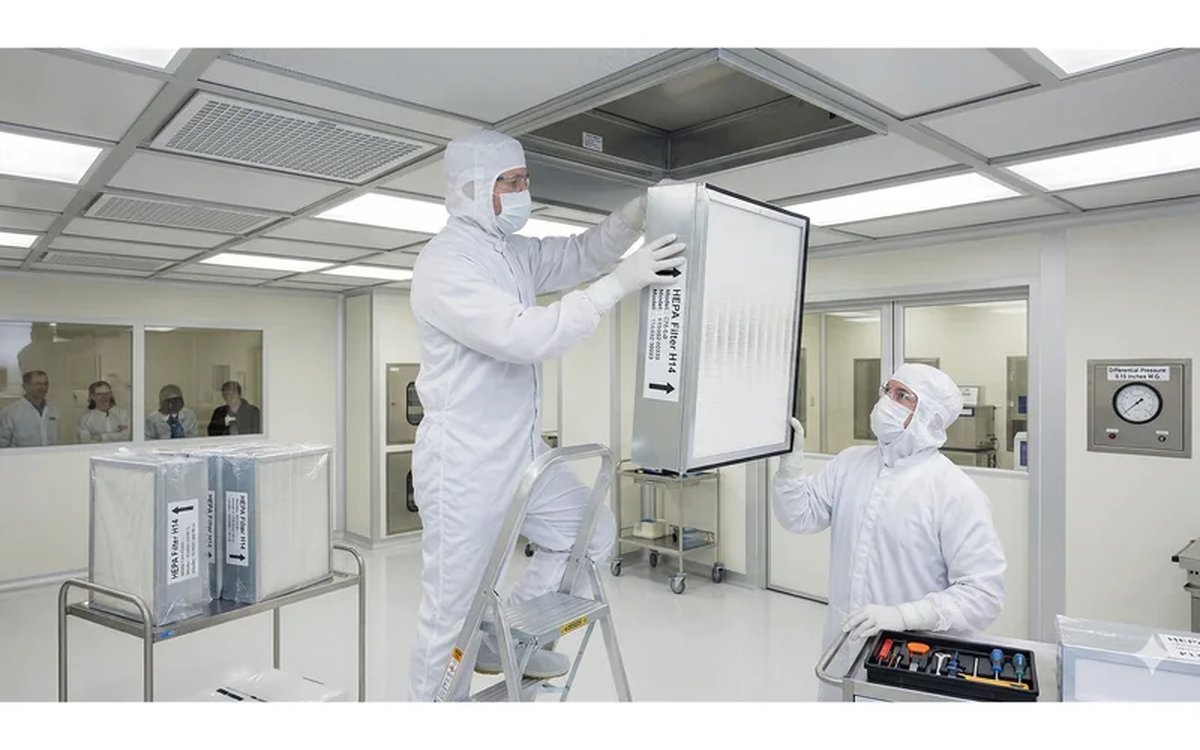
Most people who die in high-rise fires are killed not by flame but by smoke inhalation. The unassuming filter sitting in the HVAC duct is what decides whether smoke can race up to the 50th floor.
Why Air Filters Need a Fire Rating
Picture an office tower: a coffee machine on the 8th floor catches fire. If the central HVAC return filter is a generic non-woven, the flame ignites it within seconds and the whole duct becomes a highway for flame and toxic smoke. Long before the fire spreads on the 8th floor, residents on the 30th floor are unconscious from the fumes.
That is why building codes regulate filter flammability. HVAC ducting is the most interconnected interior space in a building — when a filter fails, the result is simultaneous vertical and horizontal contamination.
UL (Underwriters Laboratories) defines two layers of filter fire safety:
- ▸UL94 — tests the burn behavior of the material itself
- ▸UL900 — tests the assembled filter inside an air duct (flame spread + smoke generation)
A truly "fire-rated filter" needs to pass both.
UL94: Material-Level Flammability Grading
UL94 is UL's standard burn test for plastic materials. A 125 × 13 × 3 mm coupon is ignited vertically or horizontally with a Bunsen burner, and the lab measures:
- ▸How many seconds until self-extinguish after the flame is removed?
- ▸Do burning droplets fall and ignite cotton placed underneath?
Grades, strictest first: V-0, V-1, V-2, HB (V = Vertical burn, HB = Horizontal Burning).
Chart 1: UL94 Flammability Ladder (highest → lowest)
Same plastic, four grades — sorted by self-extinguish speed and whether burning droplets fall
| Grade | Vertical burn time | Drips | Typical filter use |
|---|---|---|---|
| V-0 | ≤ 10 s self-extinguish | No drips | Premium HEPA frames, data centers, commercial HVAC |
| V-1 | ≤ 30 s self-extinguish | No drips | Industrial HEPA frames, cleanrooms |
| V-2 | ≤ 30 s self-extinguish | Drips allowed (may ignite cotton) | Low-risk areas, general medium filters |
| HB | Slow horizontal burn (≤ 75 mm/min) | Not graded | Single-use pre-filters, low-risk |
UL94 tests only "material coupons" (~125×13×3 mm) under a Bunsen burner. The full filter assembly behavior is governed by UL900 instead. V-0 is the typical spec for premium air-filter frames/housings; HB is reserved for low-risk or single-use parts.
For air filters, the frame, housing, sealant, and separators — the plastic or composite parts — are what UL94 grades. Premium products (HEPA / ULPA, commercial HVAC, data centers) almost always require V-0; office pre-filters and consumer purifiers may use V-2 or HB.
Trivia: When you buy a consumer air purifier, the spec sheet often mentions a "V-0 flame-retardant housing" — that refers to UL94 V-0.
UL900: System-Level Flame and Smoke Test
UL94 looks at material; UL900 looks at the assembled filter. Why two layers? Because a compliant frame does not guarantee that the assembled filter, mounted in a duct, will not propagate flame or generate smoke. Will the media (fiberglass, PP, synthetic) ignite? Do the pleat gaps trap combustible gases? Will molten sealant drip? UL94 cannot answer these.
UL900 uses the Steiner Tunnel — a ~7.6 m fire-rated duct that mimics a real HVAC environment:
- 1The complete filter is mounted inside the tunnel
- 2One end is ignited with a gas burner; the other end has a fan pulling air
- 3Flame spread distance and smoke generation are measured
- 4Both metrics must pass for Class 1
Chart 2: UL94 vs UL900 — Two Levels of Fire Testing
One tests "the material itself", the other tests "the complete filter inside an air duct" — both are needed for a true fire-safe filter
Common myth: "If my frame is UL94 V-0, I pass UL900." Wrong. A compliant frame does not guarantee that the assembled filter, mounted in a duct, will not propagate flame or generate dangerous smoke. In practice you need both — UL94 governs the material, UL900 governs the system.
Historically UL900 had Class 1 (Pass) and Class 2 (greater flame spread but acceptable), but Class 2 was retired in 2008. Today, "passing UL900" means Class 1.
Where UL900 Is Mandatory
In the US, IBC (International Building Code), NFPA 90A (HVAC fire protection), NFPA 130 (rail transit) and ASHRAE 170 (healthcare air) all reference UL900 as a baseline. Equivalent requirements exist in Taiwan Building Technical Regulations §94, §259 and most other major jurisdictions.
Common application sectors include:
Chart 3: UL900-Required Sectors & Low-Pressure-Drop Needs
Building codes mandate UL900 Class 1 for filters in these sectors — many also require very low pressure drop
In the US, IBC (International Building Code), NFPA 90A (HVAC fire protection), NFPA 130 (rail transit) and ASHRAE 170 (healthcare air) all reference UL900 as a baseline. Equivalent requirements exist in Taiwan Building Technical Regulations §94, §259 and most other major jurisdictions.
Note the "Low ΔP need" tags on the right — even within UL900-required sectors, tolerance for pressure drop varies widely. Data centers, semiconductor cleanrooms, medical devices — anywhere with limited fan static pressure — need fire safety AND extremely low pressure drop.
Why Pressure Drop Matters Just as Much
There are plenty of fire-rated filters on the market. Many will choke your equipment. The reason is simple:
- ▸Equipment fans have limited static pressure — projector cooling fans 30–80 Pa, server racks 100–150 Pa, FFUs 100–150 Pa
- ▸A high-ΔP filter → insufficient airflow → overheat, performance loss, or thermal shutdown
Concrete example: your projector. Inside is a small air filter that prevents dust accumulating on the LCD panel or optics. That filter must pass UL900 (a projector that catches fire cannot become a flame source) but it only has ~30 Pa of pressure budget. A standard MERV 8 non-woven at 60 Pa would trip the lamp over-temp protection within minutes.
The classic answer is 3M HAF (High Air Flow) electret media:
- ▸Built on melt-blown polypropylene — fluffy, inherently low mechanical ΔP
- ▸Adds electret (driven dipole) charge — captures particles by static attraction rather than mechanical interception, keeping efficiency high while ΔP stays low
- ▸Carries UL900 Class 1
- ▸Typical ΔP 25–30 Pa at rated flow, about 1/3 of standard MERV 13
Chart 4: Low-ΔP Device Filters — Why UL900 + Low Pressure Drop Matter Together
The smaller the available fan static pressure, the less budget for filter ΔP. Electret media like 3M HAF (High Air Flow) is the classic answer — UL900 Class 1 with only 25–30 Pa drop, used in projectors, servers, and medical devices
| Device / scene | Filter type | Fan static (available) | Filter ΔP |
|---|---|---|---|
Projector / business imaging ΔP < 1/2 of fan static | Electret non-woven (3M HAF)3M HAF class | 60 Pa | 25 Pa |
Server rack front panel Must not throttle cold-aisle flow | Electret media (HAF class)3M HAF class | 100 Pa | 30 Pa |
Medical respirator / O₂ concentrator Battery powered, every watt counts | PP electret HEPA (HAF class)3M HAF class | 80 Pa | 40 Pa |
Air purifier / IAQ device Silence is a feature — high ΔP means noise | Electret + carbon composite3M HAF class | 120 Pa | 35 Pa |
Office HVAC pre-filter Standard pre-filter; some ΔP tolerated | Non-woven MERV 8 | 250 Pa | 60 Pa |
Data center ICU-grade HEPA Efficiency first; needs a strong AHU | H13 fiberglass HEPA | 400 Pa | 250 Pa |
A projector cooling fan only delivers 30–80 Pa of static pressure. If the filter eats 60 Pa, there is not enough flow left to carry away lamp heat — the over-temp protection trips and the unit shuts down. That is why such devices demand media that is both UL900 Class 1 AND extremely low ΔP.
Every additional 50 Pa of filter ΔP raises HVAC fan energy by roughly 8–15% (depending on the fan curve position). For 24/7 data centers and hospitals, that compounds to thousands of dollars per year. For small devices (projectors, purifiers, respirators) with <100 Pa static pressure, exceeding the ΔP budget directly causes overheating, performance loss, or alarms.
This is why projectors, server rack panels, air purifiers, medical respirators, oxygen concentrators — all the "static-pressure-sensitive" applications — almost universally use HAF-class electret media: UL900 plus low ΔP, both at once.
Even Large HVAC Cares About ΔP
It is not just small devices. Large HVAC systems care too — for energy reasons.
Every additional 50 Pa of filter ΔP raises HVAC fan energy by roughly 8–15% (depending on the fan curve position). For a commercial tower running 24/7, this compounds to tens of thousands of dollars per year in extra utility bills.
Energy codes like ASHRAE 90.1 have been pushing "low-ΔP filters" — replacing traditional high-ΔP variants with low-ΔP equivalents at the same efficiency, including for HEPA / ULPA filters. New construction has adopted this widely.
How to Pick the Right Standards for Your Application
When asked "what filter should I use here?", screen with these three questions:
- 1Could this device or duct catch fire? Yes → UL900 Class 1 required; No → check codes
- 2Is the application HVAC, data center, healthcare, rail, semiconductor? Yes → UL900 mandatory; No → check buyer specs
- 3Is fan static pressure < 200 Pa? Yes → low-ΔP media required (HAF electret / dense-pleat HEPA); No → V-Bank or deep pleat OK
Before purchasing, ask the supplier for two documents:
- ▸UL94 certificate number (frame material)
- ▸UL900 system test report (full filter assembly)
Both must be in hand to clear engineering acceptance.
FAQ
Q: Are UL94 V-0 and UL900 Class 1 the same thing?
A: No. V-0 is a "material" burn rating; Class 1 is the "assembled filter" flame spread + smoke result. Different scopes, not interchangeable. In practice UL900 Class 1 filters typically use V-0 frames, but that is a design choice, not a standard requirement.
Q: 3M HAF vs standard HEPA — how to choose?
A: Two dimensions — efficiency and pressure drop. HEPA H13/H14 deliver high efficiency (99.95% / 99.995%) but high ΔP (200–300 Pa) — right for cleanrooms, ICU-grade data centers, "efficiency at any cost" applications. HAF-class electret has moderate efficiency (MERV 13–16 depending on grade) but very low ΔP (25–40 Pa) — right for static-pressure-limited devices and energy-sensitive HVAC. Neither is "better" — depends on which dimension is your bottleneck.
Q: Can electret filters lose their charge?
A: Yes. Electret charge degrades under heat, humidity, and oil-mist exposure — typical service life 6–12 months depending on environment. So strict environments (medical, semiconductor) never rely on electret alone — they place electret media as a pre-filter and back it up with HEPA. Consumer applications (projectors, home purifiers) follow scheduled replacement (manufacturers typically recommend 6 months).
Q: Why was UL900 Class 2 retired?
A: Class 1 vs Class 2 differed mainly in flame-spread limits (Class 2 was looser). As high-rise fire data accumulated, IBC and others judged Class 2 unacceptable, and the 2008 UL900 revision dropped it. Any current UL900 certificate is Class 1 — no need to ask.
Q: Do high-temperature filters (e.g. 500°C heat-resistant HEPA) also follow UL900?
A: Not necessarily. UL900 is designed for "ambient-temperature HVAC ducting." Heat-resistant filters used in exhaust or process applications already operate next to a heat source, and are governed by EN 1822 / JIS efficiency standards plus material temperature ratings (500°C / 800°C). If a heat-resistant filter sits where exhaust returns to general HVAC, then UL900 must be added on top.
Standards & References
- ▸UL 94 — Tests for Flammability of Plastic Materials for Parts in Devices and Appliances
- ▸UL 900 — Standard for Air Filter Units (incorporates the legacy UL 586 high-efficiency filter combustion scope)
- ▸NFPA 90A — Standard for the Installation of Air-Conditioning and Ventilating Systems
- ▸ASHRAE 52.2 / ISO 16890 — Filter efficiency grading (complementary, not exclusive, to fire ratings)